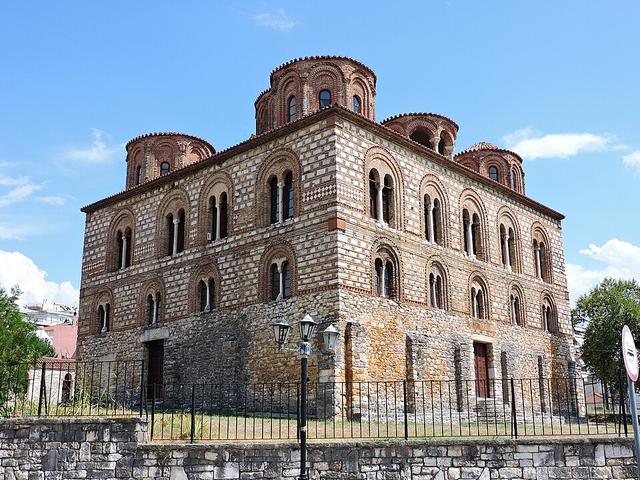
Agia Paraskevi of Drakos and its cave
An 11th-century church beside a cave with a stairway and, according to tradition, water that drips on the saint's feast.
- Dating
- Second half of the 11th century (Vokotopoulos)
- Plan
- Free cross, 10.85 × 6.70 m
- Cave
- Opening 4 × 4 m, depth up to 30 m
- Feast
- 26 July
The church of Agia Paraskevi of Drakos in Arta stands beside a cave. The archaeologist P. Vokotopoulos dated it, from its form, to the second half of the 11th century, and it is a designated monument.
The church
It has a free-cross plan measuring 10.85 × 6.70 m, with a tall cylindrical dome, a square narthex and a semicircular apse. The walls are of irregular stone and the roof of grey slate. The interior walls are plastered and unpainted. No written sources mention the church. It was set on fire in the Revolution of 1821 and parts of the walls and dome were rebuilt in the last century.
The cave
The opening is 4 × 4 m and the depth reaches 30 m. You go down by a steep staircase from the north side of the church. Inside are foundations that probably belonged to a chapel, a sign of early worship. According to local belief, on the saint's feast on 26 July water drips from the stalactites into a well beside the remains.