Byzantine monument
Panagia Parigoritissa
The great Byzantine church of the 13th century, with five domes and a mosaic of the Pantokrator.
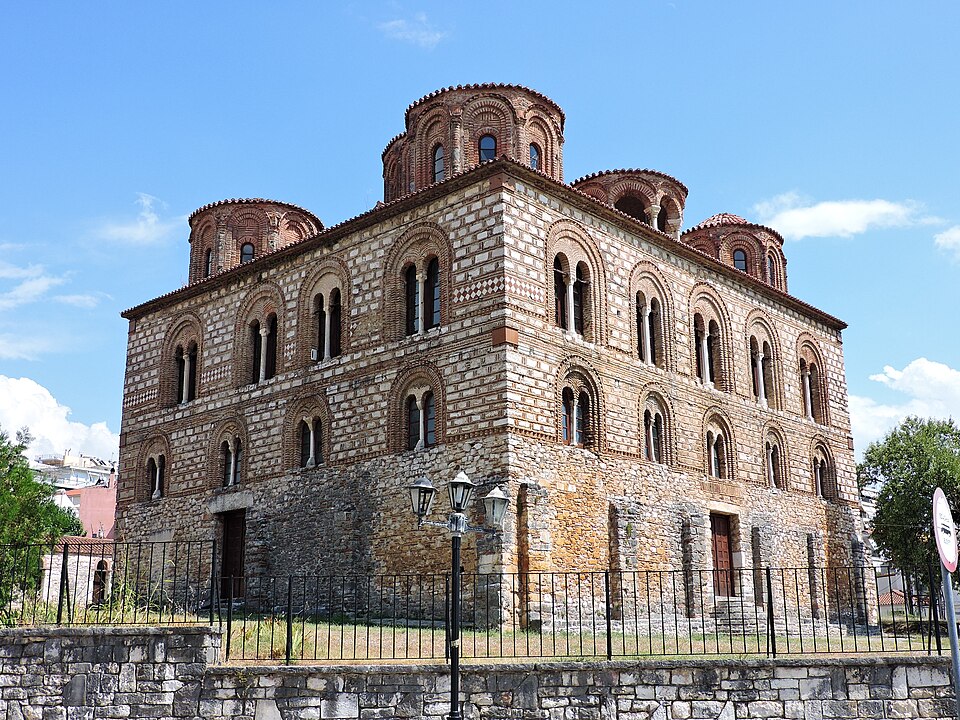
The Parigoritissa, also called “the Lady of Arta”, is the most important Byzantine church of the city. Its foundation is placed around 1250, under Michael II Komnenos Doukas or his court, and in 1290 it was restored by his son Nikephoros I and Nikephoros's second wife, Anna Kantakouzene. Sources differ slightly on the dates.
It is a large, nearly square building of three storeys, of the octagonal type. The central dome rests on eight piers arranged in three tiers, and four smaller domes stand at the corners of the flat roof, along with a lantern.
Inside
Marble covers the interior up to the galleries, and mosaics and frescoes cover the walls above. In the dome the Pantokrator is surrounded by angels, with twelve prophets between the windows of the drum. The mosaics were probably made by artists from outside Epirus.
In the altar, 16th-century frescoes by the painter Ananias survive, and the main church has 17th-century frescoes. The sculpture shows Western influence, with Romanesque monsters and reliefs of Biblical scenes. Part of the building now houses the Archaeological Collection of Arta.
Planning your visit
- Check opening hours before you go, especially if you want to see the archaeological collection.
- Combine it with Agia Theodora in the same walk.
See also
Photo credits
All photos are from Wikimedia Commons under the licences shown.
- The church of Panagia Parigoritissa: Dimitris Kamaras (Flickr), CC BY 2.0, Wikimedia Commons