City · Monument
The Bridge of Arta
The four-arched stone footbridge over the Arachthos, and the folk song that made it famous.
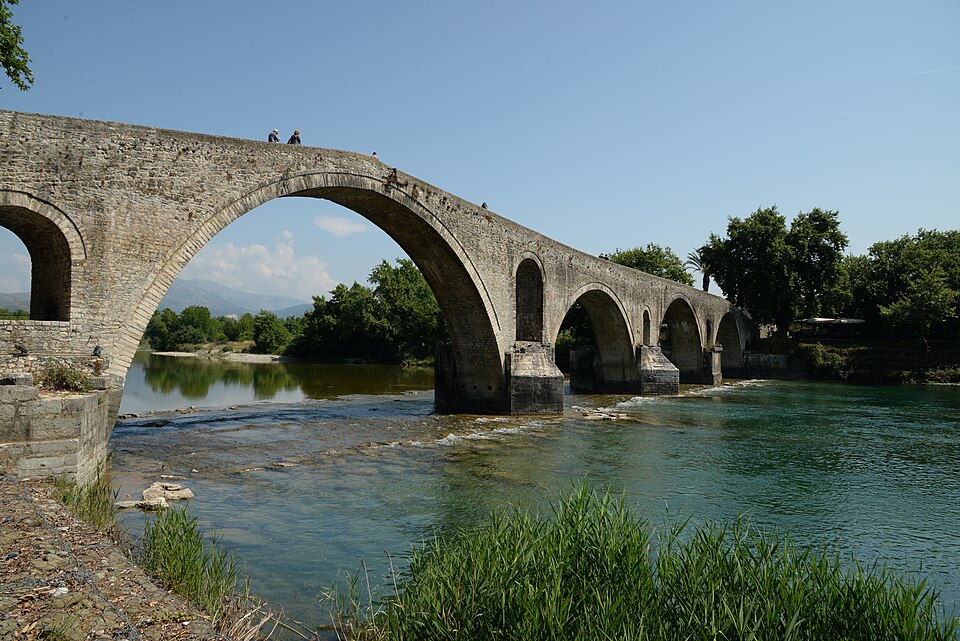
The Bridge of Arta is the symbol of the city. It crosses the Arachthos on four arches and five piers in the water, is 12 metres high and 4 metres wide, and today carries only pedestrians.
Its present form is probably a 17th-century Ottoman construction, dated between 1602–1606 and 1613. The chronicler Panayiotis Aravantinos believed a first bridge already stood here under the Roman Empire, and some traditions say it was rebuilt when Arta was the capital of the Despotate of Epirus. It has been rebuilt many times over the centuries.
A bridge that was a border
From 1881, when Arta joined the Greek state, until the First Balkan War in 1912, the highest point of the bridge marked the border between the Ottoman Empire and Greece.
The legend
In the folk ballad, the builders work all day and the foundations collapse each night. A bird tells the master builder that the bridge will stand only if he sacrifices his wife, and he walls her into the foundations. As she dies she curses the bridge and everyone who crosses it, but when she is reminded that her brother travels abroad and might cross it himself, she turns the curse into a blessing.
The song gave Greek proverbs and expressions about work that is endlessly delayed, based on the image of a project where whatever is built by day collapses by night. The motif of a sacrifice to make a building stand also appears in other Balkan tales, such as the Serbian “The Building of Skadar” and the Romanian “Meșterul Manole”.
Planning your visit
- The bridge is a footbridge and is open to walk from the city.
- For a quieter walk, go early in the morning or late in the afternoon.
- Pair it with the castle, which is close by.
See also
Photo credits
All photos are from Wikimedia Commons under the licences shown.
- The stone Bridge of Arta over the Arachthos river: Στέφανος Δ. Γαβαλάς, CC BY-SA 4.0, Wikimedia Commons