Panagia Vlacherna
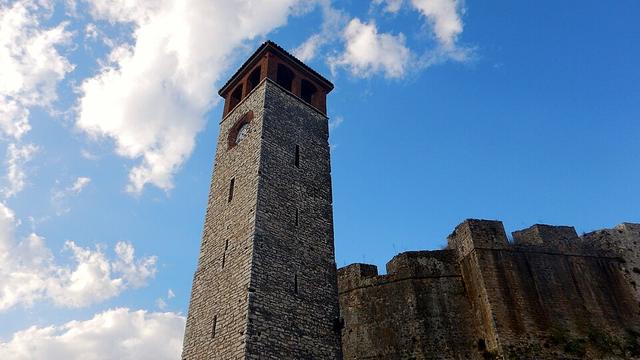
A Byzantine monastery church opposite the castle, burial church of the Komnenodoukai.
- Location
- Village of Vlacherna, about 1 km from Arta, on the opposite bank of the Arachthos
- Dating
- 10th–13th century, mostly 13th
- Frescoes
- Uncovered in 1975–1977
- Feast
- Deposition of the Robe, 2 July
Panagia Vlacherna is one of the most important Byzantine monuments of Arta. It stands in the village of Vlacherna, about a kilometre northeast of the town, on the opposite bank of the Arachthos from the castle.
History and architecture
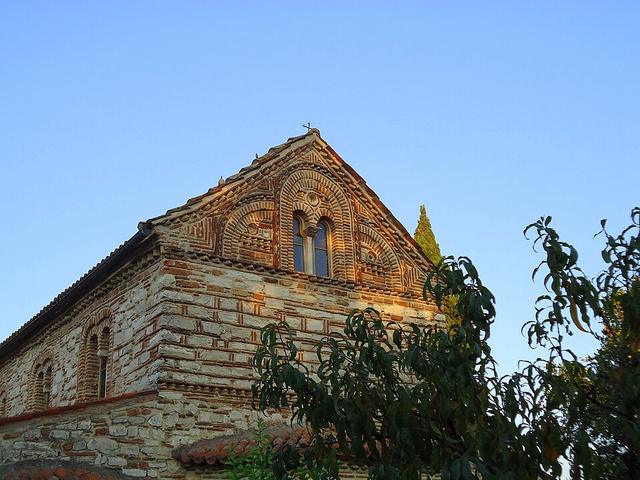
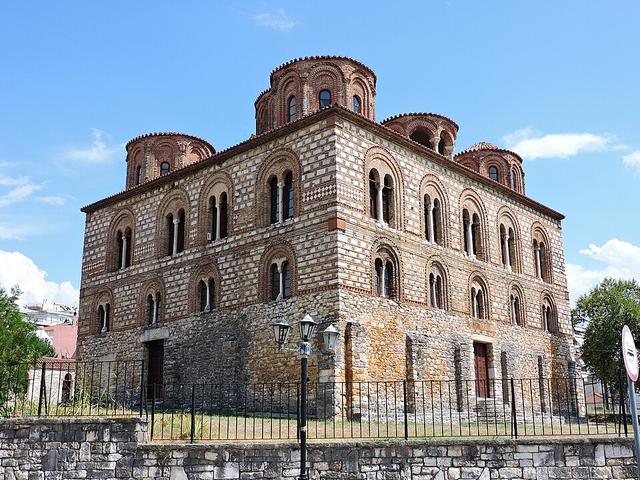
An older church of the late 9th or early 10th century stood on the site. The present church was built in the early 13th century as a three-aisled vaulted basilica and gained three domes around the middle of the century. The narthex was added at the end of the 13th century. Of the five original entrances only the central west one remains open.
Monastery and tombs
It was the katholikon of a monastery and the burial church of the Komnenodoukai, the rulers of the Despotate of Epirus. Despot Michael II and sons of Theodora Komnenodoukaina, the Saint Theodora of Arta, are buried here. The monastery was first for men and later for women.
Art
The floor has a mosaic of five interlocking circles with a double-headed eagle in the central one. Many capitals are reused from early Christian or ancient buildings. The frescoes were uncovered during the 1975–1977 restoration; the oldest date to the mid-13th century. Fragments of the marble iconostasis are regarded as a masterpiece of Late Byzantine sculpture, and a reconstruction is displayed in the Parigoritissa.